

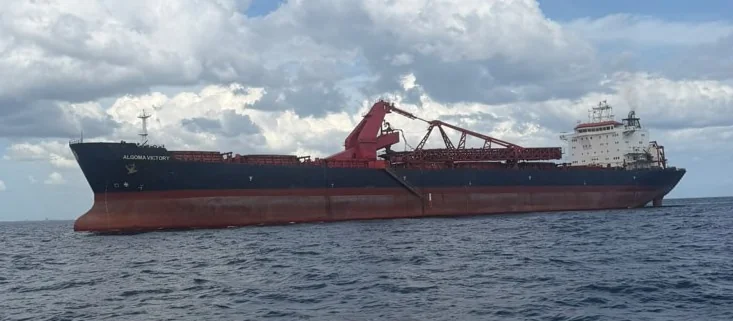
Cleaning holds between cargoes is routine on bulk carriers, but open hatch covers leave gaps that are easy to forget. This summary of the Bahamas Maritime Authority’s investigation covers what happened, the risk, and where Dtyle.AI fits.
1. Incident
At about 1350 on 1 April 2026, an ordinary seafarer on the bulk carrier Algoma Victory fell about 20 metres into cargo hold 4 while washing the ship’s conveyor boom on passage to Colombia. He was walking on top of an open hatch cover and fell through the gap between the covers.
- Vessel: the Bahamas-flagged self-unloading bulk carrier Algoma Victory, 215 metres long, managed by V-Ships, with 28 crew.
- Work: routine washing of the cargo holds, conveyor boom and deck on a two-day ballast voyage.
- Outcome: despite CPR and medical advice by phone, the ordinary seafarer sadly died.
- Investigation: carried out by the Bahamas Maritime Authority (BMA).
2. Timeline
The work went to plan in the morning; the change came after lunch.
- 1 April, 0030: Algoma Victory leaves Punta Catalina, Dominican Republic, for Colombia, less than two days away.
- About 0750: the chief officer holds a toolbox talk; the ordinary seafarer is to wash the boom’s conveyor belt from its guarded catwalk, with hatch covers opened about a metre for light.
- Morning: he washes the port side of the boom from the catwalk as planned; the chief officer checks progress at about 1000, then goes to rest.
- Shortly after 1300: he climbs onto the open hatch cover of hold 4 to wash the starboard side of the boom, and the bosun and an able seafarer see him there.
- About 1350: he falls through the gap; crew notice he is missing, the bosun finds him and calls the bridge, and he is declared dead at 1635.
3. Root Cause
The BMA found that he left the planned, protected route and worked on an open hatch cover without fall protection, and the practice wasn’t challenged.
- The plan expected him to work from the boom’s guarded catwalk, so his task wasn’t included in the working at height permit.
- Walking on open hatch covers had become normal for the deck crew, although the work plan said covers were to be washed closed.
- At least two crew members, including the bosun supervising the deck, saw him on the open cover and didn’t stop him.
- The 0.86-metre gap had no barrier or marking, and raised markers on the hatch edge were almost the same colour as the covers.
- Short voyages may have created time pressure, and the BMA couldn’t rule out fatigue from the ship’s working pattern.
4. Risk
Falls from height remain one of the most common causes of death at sea, and half of recent fatal falls were on bulk carriers.
- Open hatch covers leave long, narrow gaps with drops of up to 20 metres into the hold.
- Hoses, raised markers and wet surfaces add trip hazards right at the edge.
- Spray and concentration on a task can take attention away from where the edge is.
- Fall protection only works if it is worn and connected: the bosun wore a harness that wasn’t attached to anything.
- InterManager counted more than 100 fall accidents on ships in two and a half years, and IMO guidance isn’t expected until after 2031.
5. Early Warning Signs
The unsafe practice was visible, and even recorded, before the fall.
- The ship’s CCTV captured him walking and washing on the open hatch cover before he fell.
- The bosun spoke to him briefly while he was arranging his hose on the open cover.
- The bosun was himself working on an open hatch cover, with a harness that wasn’t clipped on.
- The work plan’s rule that covers be washed closed was regularly not followed.
6. How Dtyle.AI Helps
Dtyle.AI can’t fit barriers, check that a harness is clipped on or judge whether someone is fatigued. But this ship’s CCTV already showed the open hatch covers, and where cameras cover them, Dtyle.AI can turn that view into a live alert.
- Restricted Area Monitoring alerts when a person enters a configured zone, such as the top of an open hatch cover, and its rules can follow the work schedule so zones apply only while hatches are open.
- Unsafe Act Detection highlights behaviours the operator defines as risky, such as standing close to an open hatch gap, so they can be reviewed and coached.
- Personnel Presence Monitoring estimates how many people are visible on deck and on hatch covers, helping supervisors see who is working where.
- Live views on the operations dashboard let the officer of the watch see the deck while the supervising officer is resting.
7. Prevention
Dtyle.AI doesn’t replace barriers or markings at hatch gaps, fall protection, permits that cover every task, or supervisors who challenge unsafe practices; those are what stop a fall. Its role is to make sure someone on an open hatch cover doesn’t go unnoticed.
- An alert when someone steps onto an open hatch cover gives the bridge or deck supervisor a better chance to call them back to the catwalk.
- Event records show whether walking on open covers is a habit across the crew, so it can be corrected before it becomes normal.
- Records from each hold cleaning help check that the work is done as planned and permitted.
- Recorded clips give real examples for toolbox talks and fall-from-height campaigns.
8. Response Support
Here, crew only realised he was missing when a colleague couldn’t see him, and the bosun first thought he had gone to the restroom.
- An alert with a snapshot, the camera and the time shows where a person was last seen on deck, so the search starts at the right hold.
- Where a camera covers the inside of a hold, Slip & Fall Detection recognises a person who has fallen and remains down.
- Live views help the bridge coordinate the crew bringing an injured person out of the hold.
- Recorded clips, like the CCTV images the BMA used in its report, show the sequence of events for the investigation.
9. Lessons Learned
The ship manager has acted across its fleet, and the BMA made recommendations.
- V-Ships held a safety stand-down with all crews on hold cleaning, fall prevention, permits and supervision.
- It created a specific risk assessment for washing the cargo boom.
- A fleet campaign added warning signs at access points, and boundary lines and fall risk markings on hatch covers.
- The BMA will run a concentrated inspection campaign on falls from height across the Bahamas fleet.
- V-Ships was recommended to assess fatigue risk across its fleet, and the BMA to keep pressing for international action on falls from height.
10. Key Benefit
Early warning when people go onto open hatch covers, so a shortcut is stopped before it becomes a fall.
- Alerts when people enter zones around open hatch gaps.
- Visibility of who is working where on deck.
- Faster searches, starting from where a person was last seen.
- Recorded evidence for supervision, coaching and investigations.