

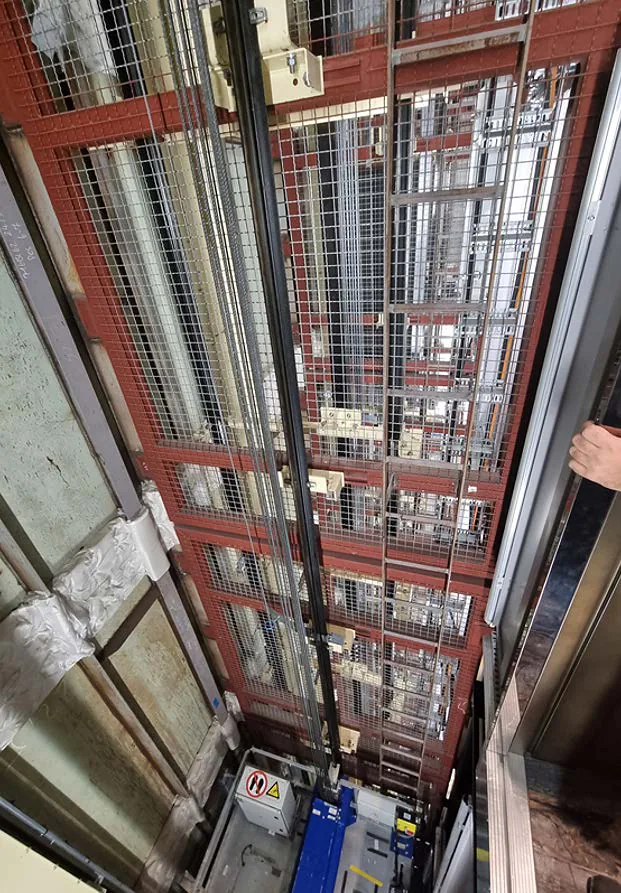
Lift maintenance is routine on a large cruise ship, but a lift that moves while someone is in its shaft leaves no time to react. This summary of the MAIB’s investigation covers what happened, the risk, and where Dtyle.AI fits.
1. Incident
At about 0552 on 26 October 2025, an electrical technician on the cruise ship Arvia was fatally injured inside a passenger lift shaft. He had entered the shaft during an inspection of overnight repairs when the lift, which had been returned to normal operation, moved up in response to a stored call and crushed him against the side of the shaft.
- Vessel: a 344.5-metre, Bermuda-registered passenger ship managed by Carnival UK, built in 2022.
- On board: 6,980 people (5,299 passengers and 1,681 crew), on passage from Southampton to Tenerife, about 75 nautical miles north-west of Cape Finisterre, Spain.
- Outcome: the technician died, and the ship diverted to A Coruña, Spain.
- Investigation: carried out by the UK’s MAIB on behalf of the Bermuda Ship Registry.
2. Timeline
The lift had stopped working after a stormy passage, and repairs ran over two nights.
- 24 October 2025: in Southampton, passenger lift 14 is found stuck at deck 11 after rough weather on the previous voyage.
- Night of 24–25 October: the deck 12 door release fails, so technicians reach the lift car top by the shaft ladder from deck 14 and make a temporary cable repair.
- Night of 25–26 October: a blown fuse is replaced and the lift is tested; at about 0530 the work is reported complete.
- 0544–0551: during a test run with a senior officer, the lift is back in normal mode; the officer decides to inspect a repaired bracket, and the technician opens the deck 14 landing doors.
- 0552: the technician enters the shaft, the doors close behind him and the lift moves up; he is found at 0601 and pronounced dead at 0607.
3. Root Cause
The MAIB found that the lift moved because both sets of open landing doors had closed, restoring its safety circuit, and it answered a call for deck 17 that was still stored.
- Positive control of the lift, using inspection mode and the emergency stop, wasn’t established before the technician entered the shaft.
- The work relied on door interlocks that reset automatically when the doors closed, so they weren’t an effective barrier.
- The officer intended to inspect from the landing, while the technician believed he needed to reach the car top; neither realised their plans differed.
- The unplanned inspection fell outside the permit to work, with no permit revision, job safety review or agreed method of work.
- Permits were authorised hours before work started by an officer on day shift, who couldn’t check that the precautions were really in place.
4. Risk
Lift shafts combine moving cars, counterweights and drops of several decks, and a lift can move as soon as its safety circuit is restored.
- A person in a shaft can be crushed by the car or counterweight, or fall from height.
- Self-resetting interlocks protect workers only while the doors are held open.
- A lift returned to service can respond to stored calls without warning.
- The MAIB cited three similar lift fatalities on other ships between 2007 and 2015.
5. Early Warning Signs
Several warning signs built up over the two nights of repairs.
- The deck 12 door release failed repeatedly, and the team kept working around the fault.
- Access by the shaft ladder from the deck above became routine because it had been used several times without incident.
- Team members rode on the lift car top while testing it in normal mode, against the manufacturer’s rules.
- The officer supervising the night work and raising the permits had no formal lift safety training.
- The technician’s shout of “OK boss” wasn’t clarified before he entered the shaft.
6. How Dtyle.AI Helps
Dtyle.AI can’t see inside a lift shaft, read a lift’s controls or stop a lift, but where cameras cover lift landings and work areas, it makes shaft access and lone working more visible.
- Restricted Area Monitoring alerts when a person enters a configured zone, such as an open lift landing doorway or a lift machinery space.
- Personnel Presence Monitoring estimates how many people are visible at a work area, helping supervisors see when a task that needs a safety attendant has only one person present.
- Unsafe Act Detection highlights behaviours the operator defines as risky, such as entering an open lift shaft from a landing, so they can be reviewed and coached.
- Live views on the operations dashboard let the supervising officer see the landings involved in a lift job, instead of relying on shouted calls between decks.
7. Prevention
Dtyle.AI can’t put a lift into inspection mode, check that an emergency stop is pressed or replace permits, lock-out and lift safety training; positive control of the lift has to come from those. Its role is to make it harder for an unplanned change in a lift job to go unnoticed.
- Alerts and records of each shaft entry show the officer who authorised the permit how the work is really being done, including access by the shaft ladder.
- Presence counts help confirm that a safety attendant is in place before anyone enters a shaft.
- Live views help a supervisor notice when a task moves to a different deck or access route, a cue to pause and re-check the permit.
- Recorded clips of crew riding on a car top or entering shafts give real examples for toolbox talks and lift safety training.
8. Response Support
When something goes wrong in a lift shaft, responders first need to know where the person is and what happened.
- An alert gives the camera and the time of the last shaft entry, helping responders work out which part of the shaft to check.
- Live views of the landings help coordinate the people opening doors on different decks.
- Recorded clips, like the lift foyer CCTV still the MAIB used in its report, show the sequence of events for the investigation.
9. Lessons Learned
Carnival UK has taken action across its fleet, and the MAIB made one recommendation.
- Senior electro-technical officers were told to reiterate the lift maintenance rules to their teams, including clear communication between everyone involved.
- Using the fixed shaft ladder to reach the lift car top is now prohibited, and permits must be managed correctly.
- Lift safety training materials were updated with the manufacturer’s safety information.
- Everyone working on lifts must have completed basic lift safety training in the last six months, followed by a recorded assessment.
- The MAIB recommended that Carnival UK review the use of self-resetting door interlocks as a safety barrier during lift maintenance and inspection.
10. Key Benefit
Better visibility of who is entering lift shafts and how lift work is really being done, so supervisors can step in before an unplanned change leads to harm.
- Alerts when someone enters an open lift landing or machinery space.
- A visual check that a safety attendant is present.
- Supervisors who can see the work, not just sign for it.
- Recorded evidence for investigations, coaching and training.