

Strong winds can overwhelm a well-maintained mooring, especially on a high-sided ship that has discharged most of its cargo. This summary of the NTSB’s investigation covers what happened, the risk, and where Dtyle.AI fits.
1. Incident
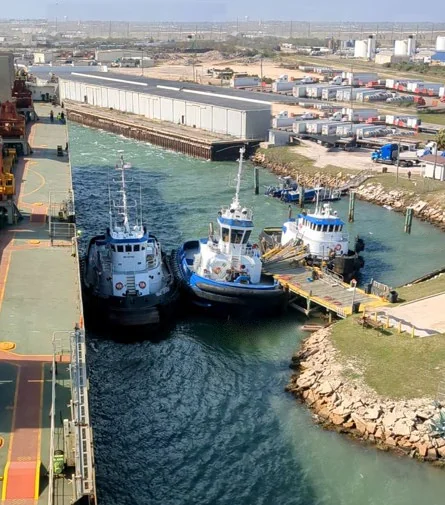
At about 1237 on 8 January 2024, the bulk carrier Chang Hang Hui Hai broke free from dock no. 12 in the Brownsville Ship Channel, Texas, during high winds. It drifted across the channel and struck the tugboat Signet Defender, which was moored at the Signet Maritime pier with two other tugboats.
- Vessel: the China-flagged, 200-metre bulk carrier Chang Hang Hui Hai, with 27 people on board.
- Condition: in ballast while discharging cargo, with about 35 feet (11 metres) of freeboard.
- Outcome: no injuries and no pollution, but the Signet Maritime pier was destroyed and a harbour police boat capsized.
- Damage: estimated at $2.5 million, including $2.1 million for the pier.
2. Timeline
The wind rose steadily through the morning, and the mooring gave way within minutes.
- 7 January, 0600: the ship moors port side to dock no. 12 with 10 mooring lines to discharge cargo.
- 8 January, 0919: an urgent marine weather message warns of a small craft advisory and a gale that evening; later that morning the chief mate has six more lines put out, making 16.
- 1235: the bow starts to move off the dock; by 1237 the bridge wind indicator reads 50–55 knots and the forward lines are parting.
- 1240–1243: both anchors are let go, but the ship drifts across the channel and pulls two bollards off the dock.
- 1249: the ship strikes the Signet Defender, pushing it into the Signet Magic and the pier into the Signet Ranger; by 1603 tugs and a pilot have it back alongside.
3. Root Cause
The NTSB found that the probable cause was the force of the wind on the ship’s exposed freeboard, which overcame the breaking strength of several mooring lines.
- The ship was riding higher as it discharged cargo, so the wind had more of its side to push against.
- The wind struck the ship almost side-on, pushing it straight off the dock.
- When the forward lines parted, the remaining lines took the extra strain and failed in turn: 10 lines parted, one paid out and two bollards gave way.
- All 16 lines in use were certified and had been rated “good” at their last inspection on 21 December 2023.
- The lines and bollards weren’t tested afterwards, so investigators couldn’t rule out weakened lines or overloaded bollards.
4. Risk
A ship breaking free in a narrow channel can hit anything in its path, and parting mooring lines endanger everyone nearby.
- A parting line can snap back with enough force to kill or seriously injure people on deck or on the quay.
- High-sided ships in ballast catch far more wind than loaded ones.
- With the main engine shut down alongside, it takes time to have power available.
- Lines floating in the water can foul the propeller, which is why the master didn’t use the engine at first.
- A drifting ship can damage other vessels, piers and small craft; here, a tug’s propeller wash during the response capsized a harbour police boat.
5. Early Warning Signs
The weather gave hours of warning and the crew responded, but the wind rose faster and higher than forecast.
- The urgent marine weather message came more than three hours before the breakaway.
- A Coast Guard officer who boarded at 1034 noted that the winds were “starting to pick up”.
- A wind advisory at 1147 warned of gusts up to 39 knots, but minutes after the breakaway the bridge recorded 59 knots.
- The ship’s freeboard, and so its wind load, was increasing all morning as cargo came off.
- Every available line except the spares was already out, leaving no margin if the wind kept rising.
6. How Dtyle.AI Helps
Dtyle.AI can’t measure wind, line tension or the load on a bollard, and it can’t hold a ship alongside. Where cameras cover the mooring stations and the quay, it helps protect people while lines are under extreme load and gives the bridge a clearer view of the mooring.
- Mooring Operation Monitoring detects people inside configured snap-back and line-of-fire zones while mooring lines are under load, such as crew putting out extra lines in a rising wind.
- Restricted Area Monitoring alerts when a person or vehicle enters a configured zone on the quay, such as the area around bollards holding straining lines.
- Berth Monitoring gives terminal teams visual awareness of moored vessels and the activity around them.
- Live views of the forward and aft mooring stations on the operations dashboard let the bridge watch the lines alongside its wind readings.
7. Prevention
Dtyle.AI doesn’t replace weather monitoring, a mooring plan for the expected wind, tugs on standby or an engine kept ready; those are what keep a ship alongside. Its role is to keep people safe and informed while the crew manage the mooring.
- Snap-back zone alerts help keep crew out of the line of fire when lines are close to breaking.
- Quay zone alerts help keep line handlers and vehicles clear of bollards under heavy load.
- Live views give the bridge a better chance to spot a parted line, or the bow moving off the dock, as early as possible.
- Recorded clips from past high-wind days help crews and terminals review how mooring arrangements held up and plan for the next gale.
8. Response Support
Here, the ship went from a holding mooring to drifting across the channel in about seven minutes.
- An alert with a snapshot, the camera and the time helps the bridge and the terminal confirm quickly what is happening at each mooring station.
- Personnel Presence Monitoring estimates how many people are visible at the mooring stations, helping confirm that everyone is clear of parting lines.
- Where cameras cover the water astern, live views help the master see lines floating near the propeller before using the engine.
- Recorded clips show the order in which lines and bollards failed, supporting the investigation alongside testing of the lines themselves.
9. Lessons Learned
The NTSB made no formal recommendations in this report, but its findings point to practical lessons for crews and terminals.
- A ship’s wind load rises as it discharges cargo, so a mooring that holds in the morning may not hold by midday.
- Once a few lines part, the rest take extra strain and can fail one after another, as 10 lines and 2 bollards did here.
- An engine shut down alongside isn’t available at once, and lines floating in the water can stop it being used at all.
- Without testing lines and bollards after a breakaway, the cause of their failure can’t be fully established.
10. Key Benefit
Safer mooring stations, and a clearer view of the mooring for the bridge and the terminal when the weather turns.
- Alerts when people enter snap-back zones while lines are under load.
- Alerts when people or vehicles approach bollards holding straining lines.
- Live views of the mooring stations for the bridge and the terminal.
- Recorded evidence for investigations, mooring reviews and training.