

Topping up a sewage treatment plant is a small, routine job, yet it can bring two reactive chemicals together. This summary of the German Federal Bureau of Maritime Casualty Investigation’s (BSU) report covers what happened, the risk, and where Dtyle.AI fits.
1. Incident
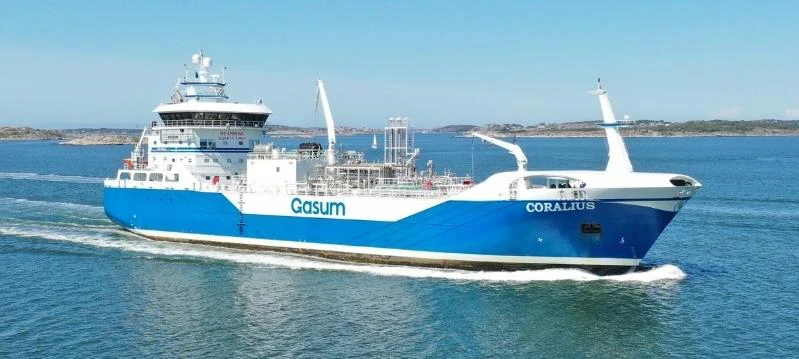
On 5 August 2024, a motorman on the LNG tanker Coralius went to refill a sodium hypochlorite dosing tank in the port of Travemünde, Germany, but poured in sodium bisulphite by mistake. The two chemicals reacted violently, the plastic tank burst, and toxic gases spread through the engine room.
- Vessel: a Swedish-flagged LNG tanker built in 2017, 99.6 metres long, with 13 crew, preparing to leave after bunkering another ship.
- Equipment: a sewage treatment plant that disinfects with sodium hypochlorite and then neutralises the chlorine with sodium bisulphite.
- Outcome: the motorman suffered chemical burns and eye injuries and was treated in hospital, with a prognosis of full recovery; other crew felt unwell after breathing the gases.
2. Timeline
All times are local on 5 August 2024.
- 1023: bunkering finishes and the Chief Engineer begins preparing for departure.
- 1047: the dosing tank bursts with a loud bang, which the crew first suspect came from the ballast system or the mooring operations.
- After 1047: the Chief Engineer is twice driven back by the fumes, and later reaches the platform deck wearing breathing apparatus.
- 1100: the ship starts to cast off, and at 1107 the crew contacts the Swedish telemedical service through the rescue centre.
- 1140: the motorman climbs down the pilot ladder to the pilot boat, secured against falling, and is handed to the emergency medical service about 15 minutes later.
3. Root Cause
The BSU found that the motorman meant to collect sodium hypochlorite from the chemical store but took sodium bisulphite instead. This attention-based slip went unnoticed until the chemicals mixed, and the tank burst because it was made of plastic.
- The plant’s design and canister sizes meant the chemicals had to be poured by hand, using a transfer container between decks.
- The transfer container broke the link between the storage canister’s label and the signs at the plant.
- The black and white colour-coding was inconspicuous, and the signs sat low down in a gap of under 30 cm beside pipes.
- The crew did not know that mixing the two chemicals was dangerous, and the plant’s manual did not warn of it.
4. Risk
Chemicals that are each manageable alone can be far more dangerous together, and safety data sheets generally cover one substance at a time.
- A small quantity in a plastic container can burst with enough force to injure, as well as spraying the person holding it.
- Gases released in an engine room can stop others from reaching a casualty, or from reaching the space at all.
- Long data sheets with different layouts discourage crews from reading them.
- The risk extends beyond one ship: at a major trade fair, the BSU found no chlorinating plant that clearly distinguished the two canisters or filling inlets.
5. Early Warning Signs
There were signals before the accident, though none pointed clearly to the danger of the mix-up.
- The motorman had reported the low level days earlier and was told to leave it, so the later refill was an unplanned job that no superior knew about.
- The motorman had only watched the refill once, and had seen the other chemical being used.
- The bisulphite now came from a different supplier, in a green canister outside the original colour scheme.
- The manual called for a risk assessment before the chemical tanks were installed, but neither crew nor company was aware of this and none was done.
6. How Dtyle.AI Helps
Dtyle.AI uses a vessel’s existing cameras and analyses the video on site, so its role here depends on cameras covering the engine room and chemical store. It could not tell the two chemicals apart, and it does not detect gas.
- Restricted Area Monitoring can alert the bridge when a person enters a configured zone, such as the chemical store or the area around the plant, with a snapshot, the camera and the time.
- Unsafe Act Detection can flag behaviours the operator has defined as risky in those zones, so they can be reviewed and coached.
- Personnel Presence Monitoring estimates how many people are visible in a defined area, helping show who may still be in an affected space.
- Slip & Fall Detection can alert the crew when someone in a covered area falls and stays down, for example after breathing fumes.
7. Prevention
Dtyle.AI cannot read a chemical label, check a tank’s contents, measure gas or judge whether PPE is adequate. Direct-fit containers, clear warnings, distinct colours and proper training remain the real defences. Its contribution is making an unplanned job visible sooner.
- An alert when someone enters the chemical store gives the bridge a better chance to ask what the job is and bring in an engineer.
- Reviewing recorded chemical handling can show where crews rely on transfer containers or struggle for space around a plant.
- Real footage supports toolbox talks on refilling procedures and on stopping to check before an unplanned job.
8. Response Support
The crew first took the bang for a ballast or mooring problem, and the fumes then kept people out of the space. Seeing the area without entering it is where cameras can help most.
- Where a camera covers the plant, a recorded clip can quickly show what caused an unexplained bang.
- Live views on the dashboard let officers look at covered areas before anyone goes in, though they cannot confirm that the air is safe.
- Snapshots of where people were last seen help the crew work out who may need help.
- Event records give medical teams, the company and investigators a clearer account of what happened.
9. Lessons Learned
The BSU asked the plant’s manufacturer to tell other customers about the updated manual and signs, issue a safety notice and choose more obvious colours. It also asked the International Chemical Safety Card consortium to stop offering a face shield in place of chemical goggles. Action already taken includes:
- The operator added clearer labels, a warning about mixing the chemicals, longer gloves and closed goggles at the plant.
- The operator introduced a chemical management system with risk assessments, separated storage and one-page data sheet summaries.
- The manufacturer is moving to 20-litre black and white containers that fit directly at the plant, so that decanting is no longer needed.
- The BSU also noted that the injured crew member should be assessed first if an accident happens shortly before departure, as a nearby berth could have been the quickest way ashore.
10. Key Benefit
Unplanned work in sensitive spaces becomes visible earlier, and crews get a safer first look when something goes wrong in an area they cannot enter.
- Alerts when people enter configured zones such as a chemical store.
- A live view of covered spaces before anyone goes in.
- Support for working out who may still be in an affected area.
- Real examples for chemical-handling training and audits.