

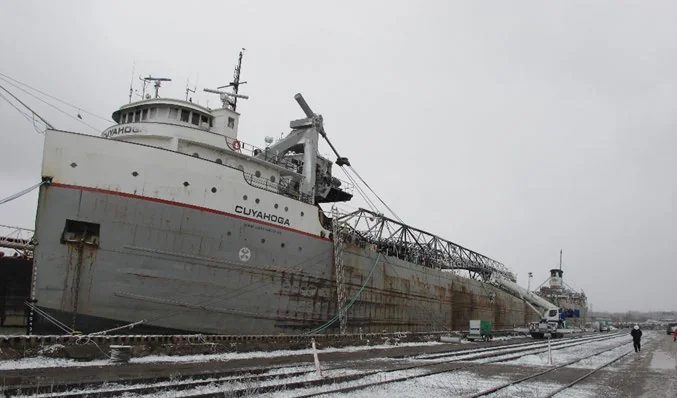
Hot work is routine during a ship’s winter maintenance, but a fire can start long after the welding has stopped. This summary of the NTSB’s investigation covers what happened, the risk, and where Dtyle.AI fits.
1. Incident
On 15 March 2024, at about 1315, a fire broke out in cargo hold no. 2 of the bulk carrier Cuyahoga while it was docked for maintenance in Ashtabula, Ohio. The crew and contractors could not put it out and evacuated, and the local fire department extinguished it that evening.
- Vessel: a 605-foot (184 m), Canada-flagged self-unloading bulk carrier, built in 1943 and converted in 1974.
- On board: 40 people, 15 crew and 25 maintenance personnel, preparing to sail for drydock two days later.
- Outcome: no injuries or pollution; the ship was declared a constructive total loss, estimated at $11 million.
2. Timeline
The ship had spent the winter laid up at Ashtabula with its firefighting equipment stowed away, while contractors carried out steel repairs in the cargo holds and tunnels.
- 0800: the crew start preparing for departure and return the fire extinguishers to their stations; the fire hoses stay locked in a storage locker.
- Morning: contractors grind epoxy paint off the forward bulkhead of hold no. 2 and weld brackets for a new ladder, with a fire watch on hand.
- 1130: hot work in the hold stops; the workers watch the area for the required 30 minutes, then leave for lunch at about 1200.
- 1300: they return, but the welding unit has no power, so no more hot work is done.
- About 1315: the fire watch sees flames on the forward bulkhead. The fire spreads up through the open hatches to the unloading boom’s conveyor belt, everyone is ordered off, and firefighters arrive at about 1330; it is declared out at about 2200.
3. Root Cause
The NTSB found that the fire was fuelled by the epoxy coating on the forward bulkhead of hold no. 2, which possibly caught fire from a smouldering fire linked to the earlier hot work.
- The hold’s epoxy coating ignites at 600–1,100°F (about 315–595°C), while the welding there could reach around 6,000°F.
- The flames appeared about 105 minutes after hot work had stopped, with no heat source in use at the time.
- A spark from the welding may have started a smouldering fire in old cargo residue or the wooden planking used as a work platform; the exact source could not be determined.
- Nobody was watching the other side of the bulkhead being welded, in hold no. 1.
4. Risk
Hot work in cargo holds brings intense heat close to coatings, residues and temporary timber that can burn, and a fire can start well after the work has finished.
- A smouldering fire burns slowly with little heat, smoke or flame, and can last for hours before flaring up without warning.
- The standard fire watch lasts 30 minutes after hot work, which a smouldering fire can easily outlast.
- Work on a bulkhead can affect the space on the other side, which here had nobody watching it.
- During lay-up, firefighting equipment may be stowed away and harder to reach quickly.
5. Early Warning Signs
There were warnings that the coating could burn, but they didn’t change how the work was watched.
- Earlier that day, the fire watch saw the epoxy paint catch fire during torch cutting; it was small and was put out with an extinguisher.
- In July 2023, the operator had told the contractor that paint must be stripped around repairs and an adequate fire watch kept at all times; the workers said they weren’t aware of any concerns about the epoxy at high temperatures.
- The hold was left unattended over lunch, about 30 minutes after hot work had stopped.
- Shortly before the fire was reported, a worker in the tunnel below heard what sounded like small stones falling onto the gates.
6. How Dtyle.AI Helps
Where cameras cover the cargo holds and work areas, Dtyle.AI keeps a visual watch on hot work and on the spaces around it, during the job and after it.
- Hot Work Monitoring gives supervisors visual oversight of welding, grinding and cutting, and flags exceptions such as a missing fire watch.
- Fire & Smoke Detection watches camera views for visible smoke and flame and alerts the duty officer with a snapshot for quick verification.
- The same cameras keep watching a hot-work area through breaks and long after the 30-minute fire watch has ended.
- Muster Monitoring and Personnel Presence Monitoring support a fast headcount when everyone has to leave the ship.
7. Prevention
Dtyle.AI can’t detect a smouldering fire before it gives off visible smoke or flame, and it can’t measure temperature or analyse coatings and residues. It doesn’t replace a fire watch, a hot-work permit or clearing combustibles from the work area.
- Flagging hot work without a fire watch in place, including on the far side of a bulkhead where cameras cover it, prompts supervisors to stop and fix it before work goes on.
- Continuous watching of the hold after the fire watch ends gives a better chance to catch the first visible smoke while a fire is still small enough to tackle with extinguishers.
- Recorded flare-ups, like the coating fire earlier that day, help supervisors spot a pattern and rethink the job before a larger fire.
8. Response Support
In this case people were in the hold when the flames appeared, so the fire was seen at once. The alert matters most when nobody is there.
- Alerts with the camera and location tell the crew exactly which hold is on fire, so they can respond and call for help quickly.
- Muster Monitoring helps confirm that all 40 people on board have left, which firefighters needed to know when they arrived.
- Live views let the master and the fire department see how the fire is spreading without sending anyone back into the hold.
- Recorded footage helps investigators establish where and when a fire started; here they had to rely on burn patterns and witness accounts.
9. Lessons Learned
The NTSB says it has investigated multiple fires caused by smouldering material after hot work had finished. Its lessons:
- Evaluate every work area for fire hazards before hot work starts.
- Move or protect combustibles, such as coatings, residues and timber, from hot work.
- Remember that a smouldering fire can outlast the fire watch and grow into a flaming fire with no warning.
- This fire also shows the value of having firefighting equipment ready: the fire hoses were still locked away when it started.
10. Key Benefit
A visual watch over hot work that doesn’t stop when the fire watch does, and faster, clearer action when a fire breaks out.
- Hot work done with its safeguards in place, and gaps flagged as they happen.
- A better chance to catch a fire while it’s still small, even when nobody is in the space.
- Faster evacuation checks and clearer information for firefighters.
- Visual records for investigations, permit reviews and contractor training.