

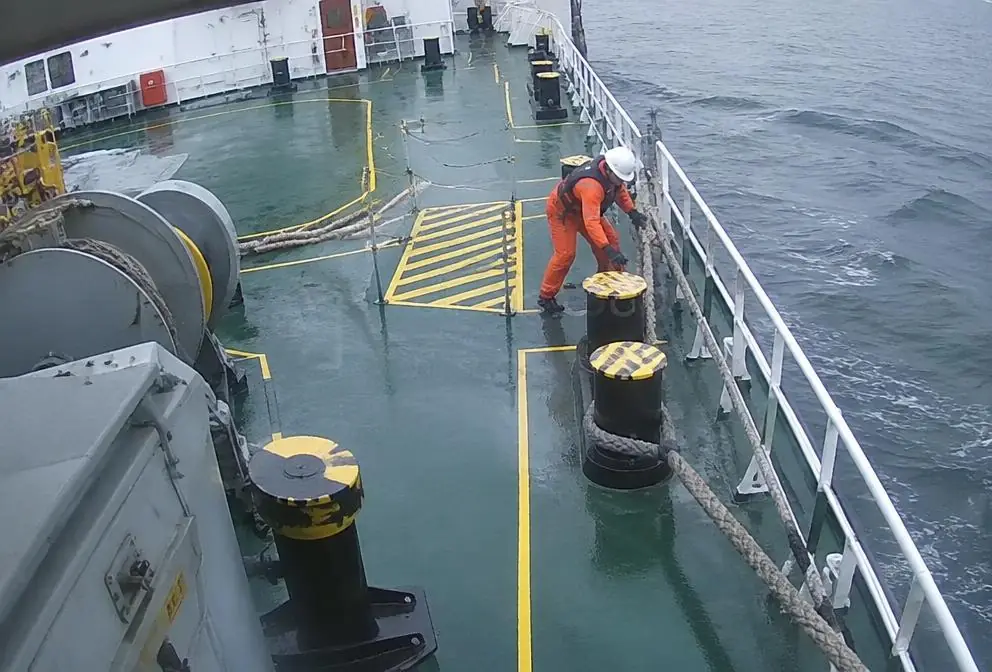
Mooring is one of the most routine jobs on a ship, and one of the most dangerous when a rope parts under load. This summary of the investigation covers what happened, the risk, and where Dtyle.AI fits.
1. Incident
On 5 May 2024, during mooring operations in the Port of Rotterdam, a mooring rope on the Fiona B fell into the water and became entangled in the ship’s controllable pitch propeller. The rope broke under tension and snapped back onto the deck, striking a crew member, who suffered fatal head injuries.
- Vessel: Fiona B (IMO 9574303).
- Location: the Port of Rotterdam, the Netherlands, during mooring operations.
- Investigation: led by Cyprus’s Marine Accident and Incident Investigation Committee (MAIC), with the Netherlands taking part as a substantially interested state.
- Outcome: one crew member died from head injuries.
2. Timeline
The published summary gives the sequence of events but not clock times.
- 5 May 2024: the ship begins mooring operations in the Port of Rotterdam.
- During mooring: a rope is released into the water in an uncontrolled way and wraps around the propeller.
- Then: the rope breaks under tension and snaps back onto the deck, fatally injuring a crew member.
- 5 May 2024: the MAIC opens its investigation the same day.
- 20 August 2025: the MAIC publishes its final report, and the investigation is closed.
3. Root Cause
The MAIC found that the immediate cause was the uncontrolled release of the rope into the water, which led to the rope becoming entangled in the propeller and snapping back.
- The rope went into the water in an uncontrolled way during the mooring operation.
- It was a non-floating rope, and no specific risk assessment had been made for using such ropes near a rotating propeller.
- Once caught in the controllable pitch propeller, the rope was pulled tight until it broke.
- Existing procedures and industry guidance didn’t adequately cover the risk of mooring ropes falling into the water.
4. Risk
Snap-back is one of the most serious hazards on a mooring deck: a rope that breaks under load releases its stored energy with little or no warning.
- A rope in the water near a turning propeller can be drawn in and put under sudden, heavy load.
- A non-floating rope sinks towards the propeller instead of staying on the surface.
- Snap-back can reach people well away from where the rope breaks, including those who think they are standing clear.
- Short-handed, tired crews and poor communication leave less margin to spot and stop a problem.
5. Early Warning Signs
Several conditions on the day made an uncontrolled release more likely and harder to catch in time.
- There was no shared understanding of the intended mooring arrangement.
- The investigation found shortcomings in how information was passed on.
- Distance and background noise hampered communication between the aft mooring station and the bridge.
- The aft station was undermanned.
- The crew member who died had already worked a long day, so fatigue may have been a factor.
6. How Dtyle.AI Helps
Dtyle.AI can’t see under the water or measure rope tension, but where cameras cover the mooring stations, it helps keep people out of the line of fire and gives the bridge a clear view of the deck.
- Mooring Operation Monitoring detects people inside configured snap-back and line-of-fire zones while mooring lines are under load, and alerts the mooring officer.
- Live views on the operations dashboard let the bridge see the aft mooring station directly, even when distance and noise make radio contact difficult.
- Personnel Presence Monitoring estimates how many people are visible at a mooring station, helping officers see when a station has fewer people than planned.
- Unsafe Act Detection highlights configured risky behaviours, such as entering line-of-fire zones, so they can be reviewed and coached.
7. Prevention
Dtyle.AI can’t stop a rope from falling into the water, detect a rope around the propeller, measure tension or monitor fatigue; those depend on risk assessments, rope handling procedures, fatigue management and clear communication. Its role is to reduce exposure and support better planning.
- Alerts when someone stands in a mapped snap-back zone give the mooring officer a better chance to move them to a safer position before a line is loaded.
- A live view of the aft deck gives the bridge a better picture of the station before it uses the propeller.
- Recorded mooring operations help officers check that stations are manned as planned, and give real examples for risk assessments and refresher training.
8. Response Support
Once a line parts, the first minutes matter for the injured person and for everyone else still on deck.
- Slip & Fall Detection can alert the bridge when a person has fallen and stays down in a covered area, with a snapshot, the camera and the time, so help can be sent at once.
- Live views help the bridge understand the situation on deck before sending more people in.
- Personnel Presence Monitoring shows how many people are still at the station.
- Recorded clips show how the operation unfolded, supporting the investigation and the company’s own review.
9. Lessons Learned
The MAIC recommended that the ship’s company:
- Give crews refresher training on safe mooring and rope handling.
- Carry out routine risk assessments.
- Strengthen the manning of mooring stations.
- Reinforce fatigue management.
- Reassess the competencies of the officers involved.
10. Key Benefit
Fewer people in the line of fire and a shared, live picture of the mooring deck, even when the stations are far from the bridge.
- Alerts when crew stand in snap-back and line-of-fire zones.
- A direct view of the aft station for the bridge, alongside radio.
- A visual check that mooring stations are manned as planned.
- Recorded operations for risk assessments, training and investigations.