

Machinery failures start out of sight, but the fire and blackout that follow put the whole ship at risk. This summary of the MAIB’s investigation covers what happened, the risk, and where Dtyle.AI fits.
1. Incident
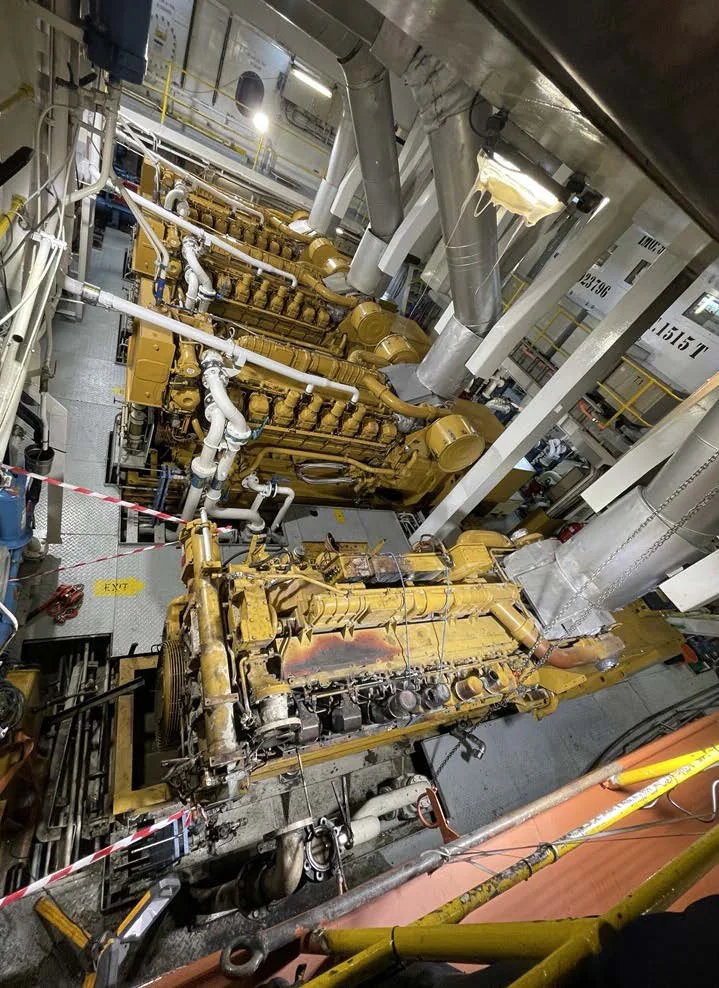
At 1305 on 25 January 2025, a diesel generator engine on the site investigation vessel Kommandor Susan failed catastrophically during sea trials in the Firth of Forth, Scotland. The failure caused an engine room fire and a complete blackout; the crew put the fire out, but the ship lost propulsion and drifted until a tug arrived.
- Vessel: an 83.7-metre, UK-registered site investigation vessel, built in 1999 as an offshore supply vessel and converted in 2019.
- On board: 14 people, leaving Leith for sea trials.
- Outcome: no injuries; generator DG1 was wrecked and later rebuilt with genuine parts, including a new engine block.
2. Timeline
The ship left Leith harbour for sea trials shortly after midday.
- 1020: the chief engineer starts generators DG1 and DG4 to warm them up.
- 1252: the vessel clears the lock and heads into the main channel of the Firth of Forth.
- 1305: a change in engine tone, a loud bang and the fire alarm; the engine room fills with smoke and oil mist.
- Moments later: both generators are stopped, causing a blackout; the emergency generator restores essential power but not propulsion, and the crew muster.
- 1416: a tug is made fast; DG4 is restarted and limited propulsion returns, and the ship berths back in Leith at 1806 with two tugs.
3. Root Cause
The MAIB found that the engine failed because of premature wear of non-genuine bearings fitted during a major overhaul in 2019.
- Pistons, connecting rods and bearings in DG1 came from a supplier not approved by the engine manufacturer, and the bearings showed weak bonding between their layers.
- The manufacturer had extended the overhaul interval to 24,000 hours, but only on the basis that genuine parts were used.
- A connecting rod bearing failed after 13,466 hours, setting off a chain of failures in which connecting rods punched through the crankcase.
- The owner at the time gave the overhaul contractor minimal oversight and never checked that the parts were genuine, so the next owner was never told.
4. Risk
A catastrophic engine failure can start a fire and cut all power at once, leaving a ship drifting with little ability to respond.
- Oil mist and oil from a broken engine can feed fires in the engine room and bilges.
- A blackout can leave a ship without propulsion, and without the power to drop its anchors.
- Drifting in a busy channel raises the risk of grounding or collision.
- Substitute parts of unknown quality can hide a defect for years.
5. Early Warning Signs
The warning signs were in the paperwork and the supply chain, not in the engine room.
- The owner knew some overhaul parts would come from the USA, but was given no supplier details or certificates.
- The overhaul ran at the same time as a major conversion project, which stretched the technical team’s attention.
- No emissions (NOx) file was required for a ship of this age, so nothing tracked which components had been fitted.
- Routine oil analysis, the last taken 19 days before the failure, showed no significant wear particles.
- The anchors were left clutched in to their electric motors, a risk the emergency procedure hadn’t identified.
6. How Dtyle.AI Helps
Dtyle.AI doesn’t monitor engine wear, but where cameras cover the engine room and muster points, it helps the crew see and manage the fire and the people involved.
- Fire & Smoke Detection watches engine room camera views for visible smoke and flame and alerts the bridge with a snapshot, the camera and the time.
- Live views on the operations dashboard let the bridge and the engine control room see conditions in the engine room before anyone opens a door.
- Restricted Area Monitoring identifies people entering configured machinery spaces, such as a fire team going into the engine room.
- Muster Monitoring supports a quick headcount at the muster stations when the general alarm sounds.
7. Prevention
Dtyle.AI can’t detect bearing wear, machine vibration or oil condition, it can’t check that spare parts are genuine, and it can’t release an anchor; those need proper contractor oversight, records and procedures. Its role is to limit how far an incident escalates once it starts.
- An alert at the first visible smoke or flame, with the exact location, helps the crew isolate fuel and ventilation and tackle the fire sooner.
- Checking the engine room on camera before entry helps the fire team plan its approach and avoid walking into dense smoke.
- Recorded footage of engine room events gives engineers and managers evidence to review alongside the maintenance records.
8. Response Support
Here, the alarm sounded at once and the crew followed their drills well. Visual information can still make a response faster and safer.
- Muster Monitoring helps confirm that everyone is accounted for before a fire team is sent in, as the crew did here.
- Restricted Area Monitoring and live views show the bridge when the fire team enters and leaves the engine room.
- Where cameras cover them, live views help locate small pockets of fire, like the burning oil the fire team found in the bilges.
- Recorded clips show how the fire and smoke developed, supporting the investigation.
9. Lessons Learned
Because of the actions already taken, the MAIB made no recommendations. The lessons and changes include:
- The current owner rebuilt DG1 with genuine parts, including a new engine block, and overhauled the other three generators with genuine Caterpillar parts.
- Anchor winch clutches must now stay disengaged when not in use, so the anchors can be dropped even after a power failure.
- The MAIB wrote to the previous owner on the need for structured supervision, clear accountability and real-time monitoring of critical maintenance.
- Extended service intervals only hold if genuine parts are used, so the parts fitted must be verified and recorded.
- Industry good practice is to keep anchors cleared away and ready to drop when navigating in pilotage waters.
10. Key Benefit
Faster visual awareness of an engine room fire and a better-managed response, even when the root cause is hidden inside a machine.
- Earlier, located alerts for visible smoke and flame in machinery spaces.
- Safer fire team entry, with conditions checked on camera first.
- Faster headcounts and clearer coordination between the bridge and the engine room.
- Visual records for investigations and maintenance reviews.