

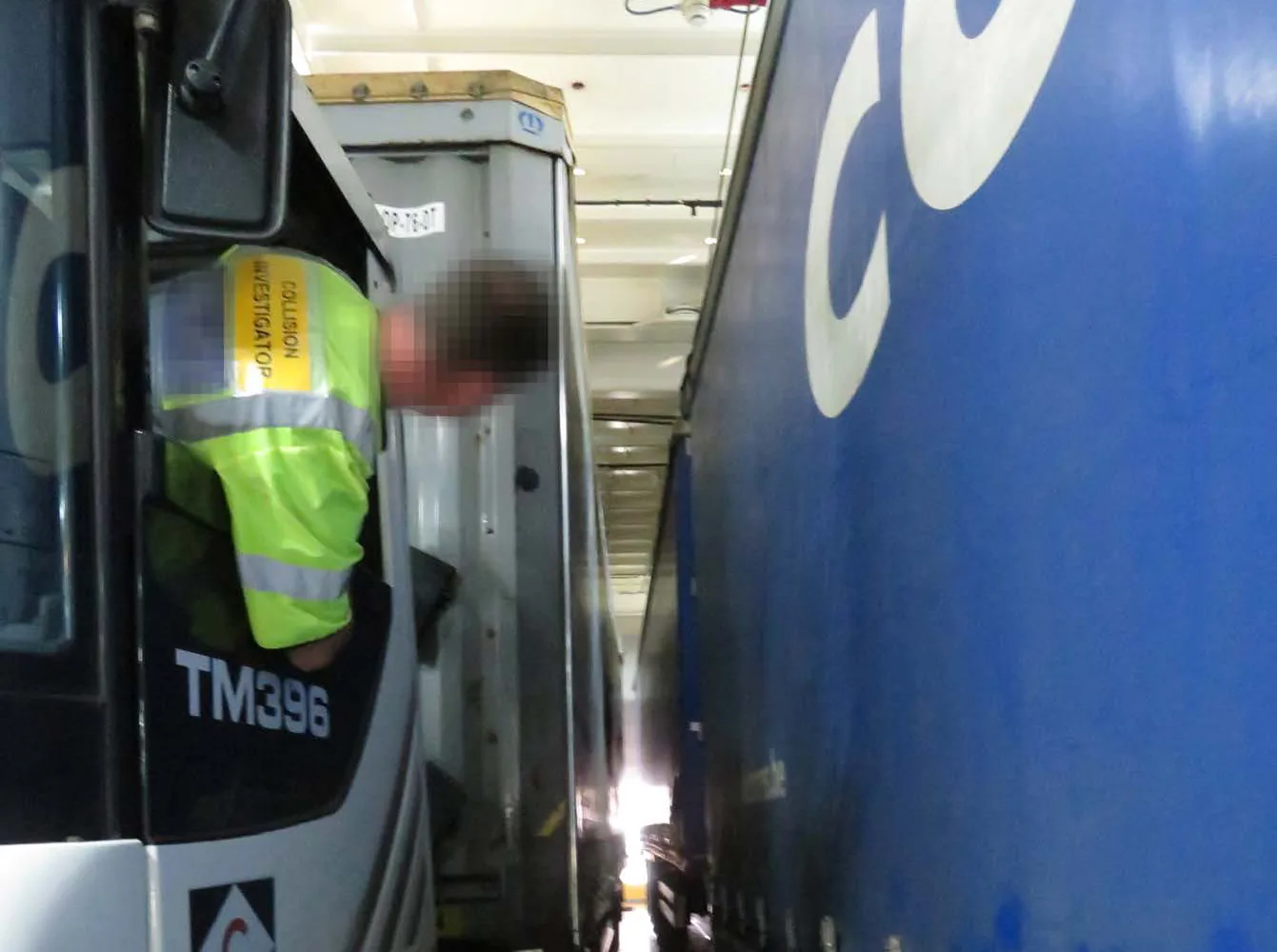
On a ro-ro ship’s vehicle deck, crew work within metres of trailers pushed into place by drivers who can’t always see them. This summary of the MAIB’s investigation covers what happened, the risk, and where Dtyle.AI fits.
1. Incident
At about 1711 on 13 July 2024, an able seaman on the ro-ro cargo ship Laureline was fatally injured while trailers were being loaded at the CLdN London terminal in Purfleet, England. He moved behind a trailer that had paused, probably assuming it was in position, and was crushed against the ship’s vent trunking when the tug driver pushed it back again to line it up.
- Vessel: the Malta-registered ro-ro cargo ship Laureline, managed by Anglo-Eastern Ship Management.
- Cargo: unaccompanied road trailers, moved on board by terminal tug drivers and marshalled into place by the ship’s crew.
- Location: the garage deck, one of four vehicle decks, where two able seamen were marshalling trailers.
- Outcome: the able seaman died at the scene; the ship and the trailer had only minor damage.
2. Timeline
There was no time pressure: the ship was staying alongside overnight.
- 1420: Laureline berths at Purfleet, and cargo work starts soon after.
- About 1650: tug drivers start loading trailers into the aft end of the garage deck, marshalled by two able seamen.
- 1706: one able seaman moves to the starboard side to deal with a blocking trailer, leaving his colleague alone on the port side.
- Moments later: the port-side able seaman waves the next trailer on and stands in the corner between the vent trunking and a stowed trailer.
- About 1711: the tug pauses for about 5 seconds, he moves behind the trailer, and the driver pushes it back again; paramedics arrive at about 1735.
3. Root Cause
The MAIB found that the able seaman and the tug driver were acting on assumptions instead of positive feedback, so neither knew what the other was doing.
- The able seaman probably believed the trailer had stopped for good, while the driver moved it again without seeing where he was.
- The ship manager’s new vehicle deck procedure, added in April 2024, was unclear and wasn’t followed, so crew regularly entered the danger zone behind moving trailers.
- The terminal’s cargo handling manual didn’t define the danger zone, so the tug driver couldn’t recognise that the able seaman was at risk.
- Tug drivers routinely kept moving when the marshalling crew member was out of sight, despite the rule to stop.
- The two able seamen were working on opposite sides of the deck, so they couldn’t watch out for each other or stop an unsafe move.
4. Risk
Vehicle decks are one of the few places where crew routinely work close to moving vehicles, often in spaces with no way out.
- Tug drivers have blind spots down the side of and behind the trailer they are pushing.
- Narrow gaps between trailers and the ship’s structure leave little or no room to escape.
- Fan and engine noise can drown out whistle signals, and two trailers moving at once can cause conflicting whistles.
- The MAIB has investigated several similar accidents, including a fatal crush on the ro-ro ship Clipper Pennant in 2021.
5. Early Warning Signs
The unsafe habits were captured on the ship’s cameras, but no one reviewed them until after the accident.
- CCTV from the two weeks before showed garage deck crew repeatedly marshalling from inside the danger zone and passing behind trailers that still had a tug attached.
- On the main deck, where the bosun supervised, crew stayed clear; the garage deck had no dedicated supervisor, and the officer in the cargo control room was busy with ballast.
- Terminal audits had found people unclear on the danger zone, or out of each other’s sight, in 16 of the 243 tug moves checked.
- Both able seamen scored highly in the training exam, but none of its questions tested the danger zone.
- The ship manager had issued four fleetwide notices in 18 months after crew were struck, or nearly struck, by moving vehicles.
6. How Dtyle.AI Helps
Dtyle.AI can’t stop a tug, signal to its driver or replace a marshaller, but where cameras cover the vehicle lanes, it can make unsafe positions around moving trailers visible to the officer in charge.
- Vehicle–Pedestrian Safety detects people close to moving trucks and trailers in shared zones, such as a crew member standing in the lane behind a trailer being reversed.
- Unsafe Act Detection highlights behaviours the operator defines as risky, such as standing in the line of fire behind a reversing trailer, so they can be reviewed and coached.
- Personnel Presence Monitoring estimates how many people are visible on each vehicle deck, helping supervisors see when crew are marshalling trailers alone.
- Alerts and live views on the operations dashboard help the officer in the cargo control room keep track of every working deck.
7. Prevention
Dtyle.AI doesn’t replace keeping people apart from moving vehicles, positive stop signals between crew and drivers, supervision on every deck or the tugs’ blind-spot cameras; those are what keep crew out of a trailer’s path. It also only sees what its cameras cover: on Laureline, the garage deck camera’s view was blocked as soon as a trailer was stowed in front of it.
- Alerts when a person is close to a moving trailer give the duty officer a better chance to radio the deck and stop the move.
- Event records reveal unsafe patterns, like those the MAIB found on CCTV, while there is still time to correct them.
- Records from each deck show where crew keep clear and where they don’t, so supervision can go where it is needed most.
- Recorded clips give real examples for toolbox talks, training and unannounced cargo safety audits.
8. Response Support
Here, the second able seaman raised the alarm by shouting and by radio, and the terminal supervisor called the emergency services.
- An alert with a snapshot, the camera and the time shows the cargo control room straight away which deck and lane are involved.
- Live views help the officer direct first aiders and keep other tugs away.
- Recorded clips, like the CCTV images the MAIB used in its report, show the sequence of events for the investigation.
9. Lessons Learned
The terminal and the ship manager have made changes, and the MAIB updated its industry recommendation.
- The terminal fitted blind-spot cameras to its tugs, kept auditing where crew stand, and showed crew the view from a tug cab.
- Anglo-Eastern issued a safety bulletin and training videos, started unannounced cargo safety audits, and translated the procedure into Filipino, Russian and Ukrainian.
- It also started reviews of its near-miss reporting system and, with CLdN, of the CCTV cameras on board.
- The MAIB recommended that the UK Chamber of Shipping and Port Skills and Safety develop an industry Code of Practice for vehicle deck safety on ro-ro ships.
- It should cover keeping people and vehicles apart, confirming that a trailer has stopped before anyone approaches, shared ship and shore signals, and using technology to improve safety on deck.
10. Key Benefit
Clear visibility of where crew stand around moving trailers, so unsafe habits are corrected before someone is hurt.
- Alerts when people are close to moving trailers and tugs.
- Records of unsafe positions on every deck, not only the supervised one.
- A visual check of how many crew are working at each trailer.
- Recorded evidence for audits, coaching and investigations.