

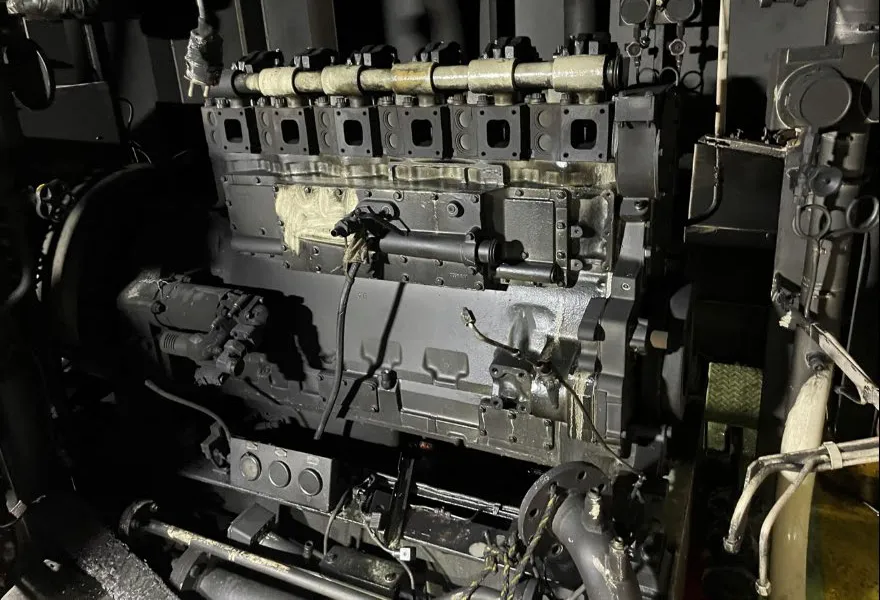
Routine engine maintenance turned into an engine room fire when one fuel line was left open overnight. This summary of the NTSB’s investigation covers what happened, the risk, and where Dtyle.AI fits.
1. Incident
On 17 May 2025, at about 0429, a fire broke out in the port engine room of the chemical tanker Scot Stuttgart while it was moored at Puerto Nuevo Terminals in San Juan, Puerto Rico, offloading molasses. The crew sealed the space and put the fire out with the fixed CO2 system, helped by local firefighters.
- Vessel: a 383-foot (117 m), Marshall Islands-flagged chemical tanker with two separate engine rooms, built in 2006.
- On board: 15 crew, with cargo operations under way.
- Outcome: no injuries or pollution; damage was estimated at $333,525.
2. Timeline
The fire started the night after maintenance on the port auxiliary generator, while the engine room was unmanned.
- 16 May, 1300: the second engineer completes a lockout/tagout permit and a cold work permit for the generator maintenance; the crew remove the fuel return tubing as part of the job.
- 16 May, about 2230: a routine round of the engine rooms finds nothing wrong.
- 17 May, 0429: a fire alarm sounds; the second engineer finds thick white smoke coming from the port engine room, and the general alarm is raised.
- 0438: after a full muster and closing the ventilation, the crew release 7 of the 14 CO2 bottles; local firefighters arrive at 0520.
- 0541–0658: firefighters open the space and start smoke-extraction fans, the smoke turns thick and black, everyone leaves, and the remaining 7 bottles are released; hotspots are put out at about 0745.
3. Root Cause
The NTSB found that the crew didn’t isolate a fuel return line during the maintenance, so diesel flowed back from the day tank, out of the open line and down onto equipment below, where it ignited.
- The return line had no check valve at the day tank, and the disconnected tubing wasn’t capped.
- The fuel purifier kept filling the day tank overnight at about 320 litres an hour, pushing fuel back through the open line.
- Diesel overflowed the generator’s drip tray and fell through the grated deck onto a powered electrical panel and hot thermal-oil lines at about 180–200°C.
- The permit’s checklist said the fuel drawings had been checked, but the open path for fuel wasn’t spotted.
- Opening and ventilating the space about an hour after the first CO2 release let oxygen back in and allowed the fire to grow.
4. Risk
Engine rooms combine fuel, hot surfaces and live electrics, so a small leak during maintenance can become a fire quickly, often when nobody is in the space.
- Fuel that splashes onto hot surfaces or into electrical panels can ignite below its normal ignition temperature.
- Machinery spaces are often unmanned at night, so a fire can grow before anyone sees it.
- A fixed CO2 system only works if the full designed amount is released and the space stays sealed.
- Opening a space too early can restart a fire that is still smouldering.
5. Early Warning Signs
The hazard was there for hours before the fire, but nothing showed it in the places people were looking.
- Fuel lines had been opened for maintenance while the day tank was still being filled.
- The isolation checklist was marked complete without the return line being isolated.
- Diesel was collecting in the generator’s drip tray and on the deck below during the night.
- The last round of the engine room was about six hours before the alarm.
6. How Dtyle.AI Helps
Where cameras cover the engine room, Dtyle.AI adds a visual watch over the space, especially when it is unmanned.
- Fire & Smoke Detection watches engine room camera views for visible smoke and flame and alerts the duty officer with a snapshot, camera and location.
- Live views on the operations dashboard let the duty engineer check a maintenance area remotely, between rounds.
- Personnel Presence Monitoring helps confirm that nobody is visible in the space before it is sealed and CO2 is released.
- Muster Monitoring supports the headcount at assembly points during the emergency.
7. Prevention
Dtyle.AI couldn’t have stopped this fire from starting: it doesn’t check valve isolation or detect fuel, vapour or electrical faults, and it doesn’t replace the certified fire detection, permits or lockout/tagout procedures.
- A smoke alert from the exact camera points the crew straight to the source, which they couldn’t find in the thick smoke here.
- Live views of an open maintenance job give the duty engineer a quick way to look over the area between rounds.
- Recorded footage of maintenance jobs supports permit reviews and training on isolating fuel lines.
8. Response Support
Once the fire had started, the hardest decision was when to open the engine room again. Visual information from inside a sealed space helps with that decision.
- While cameras inside keep working, live views show whether smoke or flame is still visible without opening the door.
- Alerts with the camera and location help the crew brief firefighters on exactly where the fire is.
- Muster and presence checks help confirm that everyone is out before CO2 is released.
- Recorded footage helps investigators pinpoint where the fire started; here they had to rely on burn patterns.
9. Lessons Learned
The NTSB’s lessons focus on isolating systems properly and getting the most from fixed firefighting systems.
- Check the vessel’s drawings to find every fuel, lube or hydraulic line that needs isolating before maintenance.
- Release the full designed amount of extinguishing agent into the space.
- Keep the space sealed long enough for the fire to die and temperatures to drop, which can take up to 24 hours.
- Since the fire, the operator has fitted check valves on the return lines, updated its lockout/tagout procedures, briefed the fleet and added thermal imaging cameras for firefighting.
10. Key Benefit
A visual watch over unmanned engine rooms and clearer information for the decisions that follow a fire.
- A faster way to find the source of smoke and see how a fire is developing.
- Better information for decisions on when it’s safe to reopen a sealed space.
- Faster headcounts before CO2 is released.
- Visual records for investigations, maintenance reviews and crew training.