

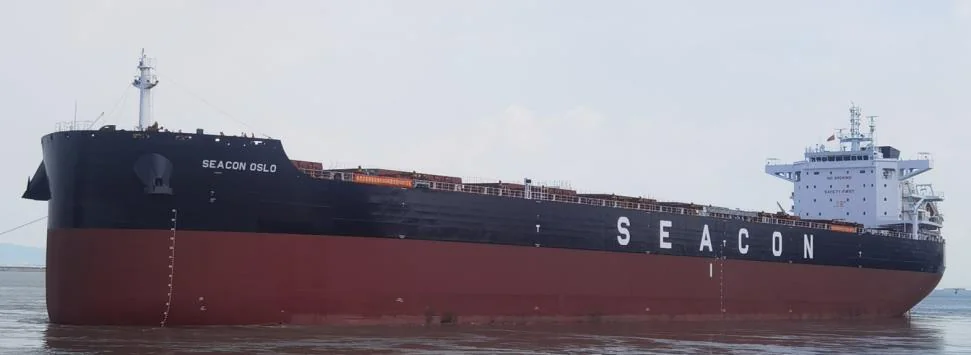
Cargo hold inspections are routine on every bulk carrier, but they mean working high above the tank top, often alone. This summary of the Singapore Transport Safety Investigation Bureau’s investigation covers what happened, the risk, and where Dtyle.AI fits.
1. Incident
On 28 October 2025, the chief officer of the bulk carrier Seacon Oslo entered No. 1 cargo hold alone, without telling anyone, and fell about 16 metres through an unguarded opening in the inspection walkway onto the tank top. He was found almost two hours later and died that evening despite first aid.
- Vessel: a Singapore-registered, gearless Panamax bulk carrier built in 2023, 228.9 metres long with seven cargo holds and 20 crew.
- Voyage: in ballast in the Mozambique Channel, heading to Durban, South Africa, to load chromite ore, while the crew cleaned and painted the holds.
- Outcome: the chief officer, the ship’s designated safety officer, died from multiple blunt force injuries; the TSIB classified it as a very serious marine casualty.
2. Timeline
All times are ship’s time on 28 October 2025.
- 0800–0825: the bosun opens the hatch covers of holds 1, 3, 5 and 7; two teams enter holds 3 and 5 after reporting to the bridge by radio.
- 0954–1002: deck CCTV shows the chief officer walking forward and last sees him between holds 1 and 2, near the aft access to No. 1 hold.
- 1130–1155: the master notices he has missed lunch, gets no answer on the radio, searches the deck and finds him lying in No. 1 hold.
- 1317: the ship turns towards Beira, Mozambique, about 287 nautical miles away, for medical help, while the crew gives first aid guided by doctors ashore.
- 1915: the master declares that the chief officer has died, and the ship resumes its voyage to Durban.
3. Root Cause
The TSIB found that the chief officer most likely missed an open metal grating in the middle of the aft inspection walkway and fell through it to the tank top.
- The hinged grating, opened to dispose of cleaning residue, had been left open by deck crew two days earlier with no guardrail or barrier around it.
- He entered the hold alone, against the company rule that at least two people enter a cargo hold together, and did not report his entry to the bridge.
- The cargo hold checklist, the working-aloft checklist and the permit to work had not been prepared or approved by the master.
- He was not wearing a safety harness or lifeline, and there was no fall arrest device in the hold.
4. Risk
Inspection walkways put people high above a steel tank top, and a fall from that height is often fatal.
- Openings made for cleaning can be left behind once the work is done, turning a familiar walkway into a trap.
- A person working alone inside a hold can lie injured for hours if nobody knows where they went.
- Senior officers who inspect holds informally can fall outside the permits and checks that cover the deck crew.
- Open hatch covers, ladders and busy cleaning schedules add to the pressure to move quickly.
5. Early Warning Signs
Several signals were there before the fall, but none reached the bridge in time.
- The grating had stood open since 26 October without a barrier, a warning sign or a check that it had been closed.
- No permit or checklist existed for No. 1 hold, so nobody expected anyone to be working there.
- The chief officer was last seen on CCTV near the hold entrance at 1002, but the footage was only reviewed afterwards.
- Nobody noticed he was missing until he did not come to lunch about an hour and a half later.
6. How Dtyle.AI Helps
Dtyle.AI uses the cameras already on board and analyses the video on site. Seacon Oslo already had deck CCTV, which captured the chief officer near the hold access before he fell.
- Restricted Area Monitoring can alert the bridge when a person enters a configured zone, such as the access hatch to a cargo hold, with a snapshot, the camera and the time.
- Unsafe Act Detection can flag behaviours the operator has defined as risky, such as entering a hold access alone, so they can be reviewed and coached.
- Personnel Presence Monitoring estimates how many people are visible in a defined area, helping officers see when someone is working in a hold on their own.
- Slip & Fall Detection can alert the bridge when a person has fallen and stays down, where a camera covers the inside of the hold.
7. Prevention
Dtyle.AI cannot see inside a hold without a camera there, check whether a grating is closed, or confirm that a permit to work exists. Guardrails, permits, harnesses and the two-person rule remain the main defences. Where cameras cover the deck, it gives the bridge an early prompt to act.
- An alert when someone enters a hold access gives the officer of the watch a better chance to ask who it is and whether a permit and a second person are in place.
- Recorded entries help officers check that hold access matches approved permits and checklists.
- Reviewing flagged lone entries in toolbox talks supports the habit of reporting every hold entry to the bridge.
8. Response Support
Here the injured officer lay undiscovered for almost two hours, so knowing where someone went matters as much as knowing that something is wrong.
- A timestamped record of entry into No. 1 hold would point the search to the right place straight away, instead of starting from the accommodation.
- Where a camera covers the hold, a person-down alert with a snapshot and location can bring help within minutes rather than at lunchtime.
- Live views on the dashboard help the bridge guide the rescue team and track how many people are inside the hold.
- Event records support the investigation and the company’s own review.
9. Lessons Learned
The TSIB issued no recommendations because the company had already acted. The company:
- Fitted safety guardrails on both sides of the hinged grating on the inspection walkways of all its bulk carriers.
- Issued a fleet circular requiring risk assessments, checklists and permits before hold cleaning, working aloft and enclosed space entry.
- Trained crews on working aloft and hold entry, including checking that openings are secured when a job is finished.
- Ran an emergency drill simulating a fall in a cargo hold.
10. Key Benefit
Lone and unplanned entries into cargo holds become visible to the bridge while there is still time to act, and help reaches a fallen crew member sooner.
- Alerts when a person enters a hold access, alongside the permit to work system.
- A clear record of who entered which hold, and when, for searches and audits.
- Faster person-down alerts where cameras cover the hold.
- Real examples for safety training and toolbox talks.