
Loading in a strong river current puts a ship’s mooring under growing strain, hour by hour. This summary of the NTSB’s investigation covers what happened, the risk, and where Dtyle.AI fits.
1. Incident
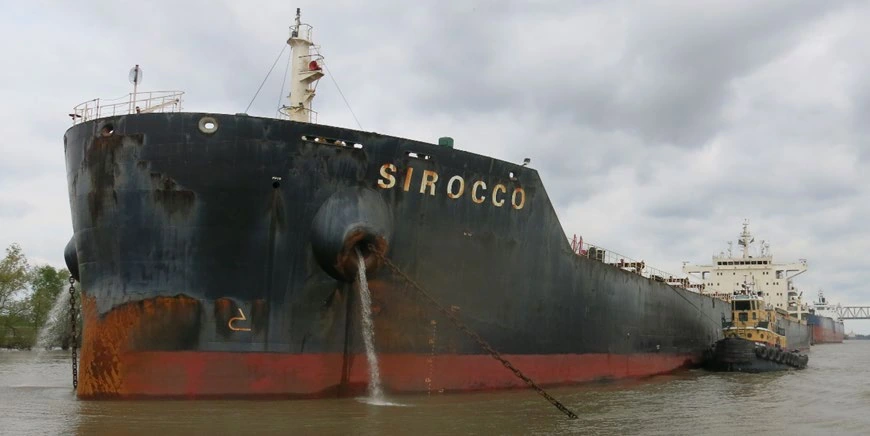
At about 0208 on 27 March 2023, the bulk carrier Sirocco broke free from the Convent Marine Terminal on the Lower Mississippi River in Louisiana while loading coal. It drifted about half a mile downriver and, at 0249, struck a barge moored at the Mosaic Uncle Sam dock.
- Vessel: the Panama-flagged, 229.5-metre bulk carrier Sirocco, built in 2014, with 31 people on board.
- Cargo: 73,014 tons of coal being loaded into seven holds, in a river current of up to 4.5 knots.
- Outcome: no injuries or pollution, but the barge MEM 5087 was a total loss, and the dock and Sirocco were damaged.
- Damage: estimated at about $5 million in total.
2. Timeline
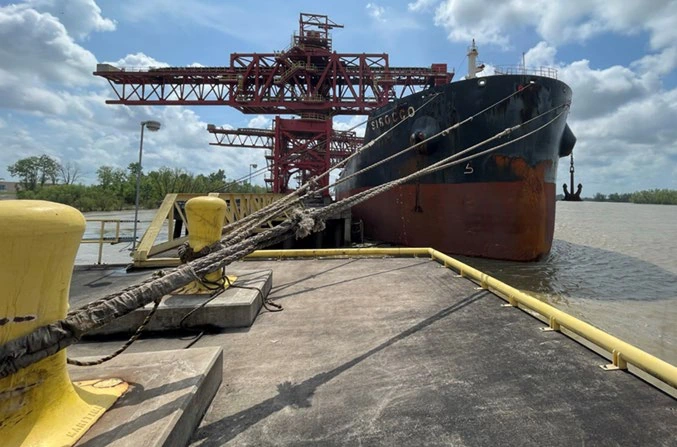
The mooring held for 11 hours after the last tug left, until loading reached the forward holds.
- 26 March, 0100: Sirocco moors bow upriver with 16 lines, with two hold-in tugs pushing it against the dock.
- 1315 and 1500: with the river below the terminal’s high-water threshold, tugs are no longer required, and both are released.
- Afternoon: the charterer’s port captain repeatedly finds slack stern lines and reminds the master to keep them tight.
- 27 March, about 0145: with loading in hold no. 2 at the bow, the crew find the bow lines very tight and the bow 1.5 metres off the dock.
- 0208–0249: the bow swings out, the forward lines pay out, the ship breaks free and, despite two tugs, hits the barge.
3. Root Cause
The NTSB found that the bow came off the dock while the forward holds were loaded, exposing more hull to the strong current until the mooring winch brakes could no longer hold the lines.
- Loading added about 18 feet to the ship’s draft, so the current pushed on more of the hull as the bow sat lower.
- The crew kept heaving in slack, but didn’t watch the bow lines closely enough as loading moved to the forward holds.
- Once the bow was off the dock, the winches couldn’t heave against the tension, and the load overcame their brakes, so the lines paid out.
- The watchkeepers also had cargo, hatch, sounding and gangway duties competing with line tending.
- The starboard anchor was let go 7 minutes after the order, with too little chain for the depth, and the port anchor later still.
4. Risk
A large ship breaking away in a busy river can hit docks, barges and other ships within minutes.
- A strong current pushes harder on a ship as it loads and sits deeper in the water.
- Lines paying out or parting under load endanger anyone near the winches or on the dock.
- With the main engine shut down alongside, power isn’t immediately available.
- Lines left in the water can foul the propellers of the ship and its tugs.
- A similar breakaway at the same terminal in 2015 led to its high-water loading plan.
5. Early Warning Signs
The forces on the mooring built up over many hours, and there were warnings along the way.
- The crew saw the current reach 3.2 to 4 knots, and the master was surprised that hold-in tugs were no longer required.
- The port captain found slack stern lines three times during the afternoon.
- The outgoing watch reported having to take slack out of the lines frequently.
- The forward draft rose quickly once loading moved to hold no. 2, the last hold to be filled.
6. How Dtyle.AI Helps
Dtyle.AI can’t measure line tension, current or draft, and it can’t hold a ship alongside. Where cameras cover the bow, the stern and the dock, it gives the watch a continuous view of the mooring between rounds and helps keep people clear of lines under extreme load.
- Live views of the forward and aft mooring stations on the operations dashboard let the officer of the watch see slack lines or the bow moving off the dock between rounds.
- Mooring Operation Monitoring detects people inside configured snap-back and line-of-fire zones while lines are under load, such as crew heading to winches that are paying out.
- Berth Monitoring gives terminal teams visual awareness of moored vessels and the activity around them.
- Personnel Presence Monitoring estimates how many people are visible in defined areas, such as a crane barge in a drifting ship’s path.
7. Prevention
Dtyle.AI doesn’t replace line tending, hold-in tugs, anchors and engines kept ready, or a breakaway plan; those are what keep a ship alongside. Its role is to make it harder for a changing mooring to go unnoticed while the watch is busy with other duties.
- Live views of the bow give the watch a better chance to spot slack lines or a widening gap while the winches can still recover it.
- Recorded video from each loading shows how the mooring behaved as the draft increased, helping plan line tending for the forward holds.
- Snap-back zone alerts help keep crew out of the line of fire while lines are under heavy strain.
- Recorded clips from past loadings give real examples for training on mooring in strong currents.
8. Response Support
Here, the crew couldn’t reach the bow while the lines were paying out, and dock workers were warned only by a tug’s whistle.
- Alerts with a snapshot, the camera and the time help keep crew away from the winches until it is safe to let go the anchors.
- Live views help the master see lines in the water before using the engine or calling tugs alongside.
- Where terminal cameras cover a dock, Personnel Presence Monitoring helps confirm workers have cleared the path of a drifting ship.
- Recorded clips, like the crane camera footage of workers leaving the barge, show the sequence of events for the investigation.
9. Lessons Learned
The NTSB set out lessons for crews mooring in strong currents.
- Understand how the current’s force grows as a ship loads and its bow sits lower in the water.
- Keep taking slack out of the bow lines as the forward holds are loaded.
- Have a breakaway response plan, so the crew know what to do if the mooring fails.
- Keep propulsion, thrusters and steering on short standby, and anchors ready for immediate use, even if the terminal doesn’t require it.
- Masters should know how to call for tug support at short notice.
10. Key Benefit
A continuous view of the mooring and the people around it, so a ship coming off the dock is noticed sooner and nobody is near the lines when they let go.
- Live views of bow and stern lines between rounds.
- Alerts when people enter snap-back zones under heavy load.
- Visibility for terminals of activity around moored ships.
- Recorded evidence for investigations, mooring plans and training.