

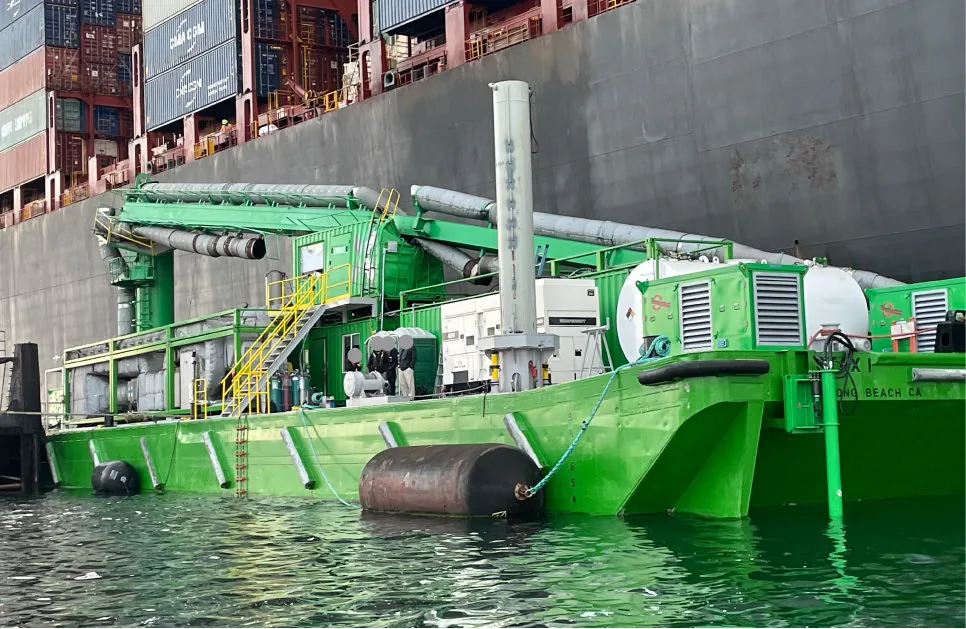
Ports are adding new equipment alongside ships, such as barges that capture exhaust emissions, and crane teams need to know it’s there. This summary of the NTSB’s investigation covers what happened, the risk, and where Dtyle.AI fits.
1. Incident
At about 1649 on 2 June 2024, a ship-to-shore container crane at the Fenix Marine Services terminal in the Port of Los Angeles was moved along the quay with its boom lowered. The boom struck the emission capture arm of the barge STAX 1, which was capturing exhaust from the containership Erving, and the arm collapsed onto the barge, the ship and into the water.
- Vessels: the US-flagged emissions control barge STAX 1, alongside the UK-flagged containership Erving.
- People at risk: four STAX 1 crew were repairing exhaust ducting on top of the Erving’s funnel, and one was in the barge’s control room.
- Outcome: the crew member in the control room had minor injuries, and about 10 gallons of hydraulic oil were released.
- Damage: estimated at $3.2 million, almost all of it to STAX 1.
2. Timeline
The barge had worked safely alongside the ship all day; the accident happened during the shift change.
- 0408: STAX 1 comes alongside the Erving’s waterside and connects its boom to the ship’s exhaust, then runs for 11 hours without incident.
- About 1605: terminal managers in the control tower agree that crane 16’s boom must be raised to clear the STAX 1 boom, and pass this to the first-shift crane operator.
- 1638: the first-shift operator finishes but can’t raise the boom; a mechanic is called and the crane is left with its boom lowered.
- About 1648: an operator arriving for the next shift moves crane 16 from its ground-level control station, wedging the travel switch and stepping about 35 feet away.
- 1649: the boom strikes the STAX 1 arm; the operator sees a STAX 1 deckhand waving and presses the emergency stop.
3. Root Cause
The NTSB found that the probable cause was a crane operator moving the crane without checking that its lowered boom would clear obstructions, and the terminal’s inadequate guidance for moving cranes.
- The boom couldn’t be raised because the operator cab hadn’t been fully parked, so the crane’s start interlocks weren’t met.
- The crane was moved from the ground, where the ship blocked the operator’s view of the barge, with no signal person and no radio.
- The travel switch was wedged so the crane kept moving while the operator watched from a distance.
- The oncoming shift hadn’t been told about STAX 1: the preliminary shift plan didn’t mention it, and the move happened before the pre-shift meeting.
- The terminal had no formal guidance or training for crane work near emission barges, and the operator’s last formal crane training was in 1998.
4. Risk
A container crane’s boom sweeps over the ship and anything alongside it, often out of the operator’s sight.
- A barge on a ship’s waterside can’t be seen from the quay.
- Exhaust stacks, superstructures and emission capture systems can all sit in a lowered boom’s path.
- People working aloft on a ship are exposed to falling equipment.
- Shift changes create gaps in who knows what is alongside a ship.
5. Early Warning Signs
The information needed to stop the move existed, but it didn’t reach the person moving the crane.
- First-shift managers knew the boom had to be raised to clear STAX 1, but the oncoming shift didn’t.
- Crane 16’s boom had failed to rise minutes earlier, and the oncoming operator had heard it was down and “not working”.
- A second-shift supervisor checked the berth at about 1615 and didn’t see the barge on the ship’s far side.
- Wedging the travel switch was common practice, and the operator didn’t know of any rule against it.
- Signal persons were usually provided for crane moves only when hatch covers had to be replaced.
6. How Dtyle.AI Helps
Dtyle.AI can’t control or stop a crane, or check that its boom is raised, but where cameras cover the quay, the berth and the ship’s waterside, it makes people, vessels and unsafe practices around cranes more visible.
- Crane & Lifting Safety detects people and vehicles inside configured crane operating zones and alerts the crane operator and signal person.
- Berth Monitoring gives terminal teams visual awareness of activity around moored vessels, including a barge working on the waterside.
- Personnel Presence Monitoring estimates how many people are visible in defined areas, such as a crane’s ground control station.
- Unsafe Act Detection highlights behaviours the operator defines as risky, such as leaving a crane’s control station while it is moving, so they can be reviewed and coached.
7. Prevention
Dtyle.AI doesn’t replace line of sight from the crane cab, a signal person, shift briefings or the terminal’s new interlocks and locks; those are what stop a lowered boom being moved. Its role is to give the people planning and making a crane move a clearer picture first.
- Live views of the ship’s waterside on the operations dashboard show the tower and the oncoming shift what is alongside, even when it can’t be seen from the quay.
- Alerts when people are inside a crane’s operating zone give the operator and signal person a better chance to stop before moving.
- A presence check at the control station helps confirm that a signal person is in place before a crane moves.
- Recorded clips of wedged switches or unattended crane moves give supervisors real examples to stop the practice before it causes harm.
8. Response Support
Here, the deckhand’s waving was the only warning, and the operator had to report the strike on his own mobile phone.
- Live views let the tower see the damage, the people on the barge and the ship, and any debris in the water straight away.
- Alerts arrive with a snapshot, the camera and the time, so the right team knows where to go.
- Recorded clips, like the terminal camera image the NTSB used in its report, show how the crane moved and support the investigation.
9. Lessons Learned
The terminal and the barge operator both made changes, and the NTSB set out lessons for the wider industry.
- The terminal fitted locks to all ground-level crane control stations, so a mechanic and other staff must be present to use them.
- The cranes’ software now blocks moving a crane from the ground with its boom lowered, and shift plans state “DO NOT GANTRY CRANES FROM GROUND”.
- STAX Engineering now displays a sign on the quay side of the ship, warning that an emissions barge is alongside, and is strengthening its barges’ control rooms and fuel tanks.
- The NTSB said crane operators must know about obstructions, keep line of sight from the cab, and use a signal person.
- It also said obstructions such as emission capture systems should be included in safety briefings and crane movement plans.
10. Key Benefit
A shared, live picture of what is alongside a ship and who is in a crane’s path, so a crane move isn’t made blind.
- Alerts when people or vehicles are inside crane operating zones.
- Visibility of barges and activity on a ship’s waterside for the tower and oncoming shifts.
- A visual check that a signal person is in place.
- Recorded evidence for investigations, coaching and training.