

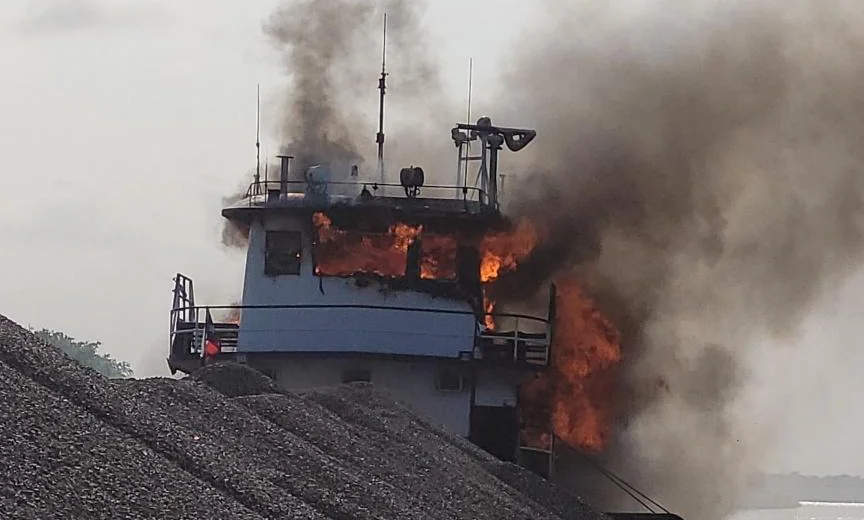
On a small vessel, a fire in one cabin can reach the wheelhouse before the crew has finished looking for it. This summary of the NTSB’s investigation covers what happened, the risk, and where Dtyle.AI fits.
1. Incident
On 22 April 2025, a fire broke out in the accommodation of the towing vessel William D while it was pushing two barges on the Victoria Barge Canal, about 15 miles from Port Lavaca, Texas. The crew could not put it out and evacuated along the barges, and the vessel was declared a constructive total loss.
- Vessel: a 95-foot, US-flagged steel towing vessel built in 1957, owned and operated by Pinnacle III LP.
- Tow: two barges of sand and gravel, heading from Victoria to San Leon, Texas, with a remotely operated bow boat at the head of the tow.
- Outcome: all six crew escaped without injury, no pollution was reported, and the loss was estimated at $500,000.
2. Timeline
All times are central daylight time on 22 April 2025, as given in the NTSB’s account of events.
- 1415: the William D leaves the dock in Victoria with its tow.
- About 1715: the wheelhouse fire panel alarms and points to one of the bunkrooms, and the captain sends two deckhands to check.
- Next: the deckhands clear the engine room and machine room, then find a flame the “size of [his] phone” in Bunkroom 1B, near the air conditioning unit and an electrical outlet.
- Next: extinguishers and a fire hose fail to stop it, the fire reaches the second deck, smoke fills the wheelhouse, and the captain orders everyone onto the barges.
- 1750: the captain calls the Coast Guard by mobile phone. The crew leaves on the bow boat, and the fire department reports the fire contained at 2200.
3. Root Cause
The NTSB found that the probable cause was likely an unknown electrical source in the starboard main deck bunkroom. The damage was too severe to identify the exact fault.
- Federal fire investigators from the ATF traced the origin to the bulkhead where an outlet powered the window air conditioning unit and a phone charger.
- They named electrical failure as the most probable cause and classified the fire as accidental.
- Air entering through open doors, windows and other openings helped the fire spread quickly.
- Wood panelling throughout the accommodation gave the fire plenty of fuel.
4. Risk
Older vessels with combustible interiors leave very little time between a small flame and losing the whole superstructure.
- Wood panelling lined the passageways, bunkrooms and the inside of the wheelhouse.
- Open doors and ladderwells created a chimney effect, drawing fire and smoke up towards the wheelhouse.
- Structural fire protection slows a fire’s spread between compartments, but the Subchapter M rules for towing vessels do not currently require it.
- The NTSB has seen combustible interiors add to the damage in earlier vessel fires, including the Mary Dupre and the Jaxon Aaron.
5. Early Warning Signs
The fixed alarm worked and gave an early warning, but the crew still had to find the fire on foot while it grew.
- The alarm panel pointed to the bunkrooms in general, and the deckhands checked the machinery spaces first.
- By the time deckhand 4 woke, heavy smoke already filled the passageway.
- The captain confirmed smoke by looking over the bridge wing, then sounded the general alarm.
- Nothing suggested a problem beforehand: the occupant said the air conditioning unit had been working normally.
6. How Dtyle.AI Helps
Dtyle.AI uses a vessel’s existing cameras and analyses the video on site. It works alongside the fixed fire alarm and needs cameras in the right places; sleeping cabins are generally not monitored, so its view starts in passageways and on deck.
- Fire & Smoke Detection can flag visible smoke or flame in covered passageways and on exterior decks, and alert the wheelhouse with a snapshot, the camera and the time.
- Live views on the operations dashboard let the captain see covered areas without leaving the controls.
- Personnel Presence Monitoring estimates how many people are visible in a defined area, helping show who is still in a covered space.
- Muster Monitoring supports a headcount at a covered assembly point.
7. Prevention
Dtyle.AI cannot detect an electrical fault inside a bulkhead, see inside a cabin without a camera, or stop a fire from spreading. Electrical inspections, less combustible material and structural fire protection remain the real defences. Its role is to shorten the time between the first visible sign and the right decision.
- A snapshot from a passageway camera helps narrow down where to look, which leaves more time to reach the fire while it is still small.
- Earlier visual confirmation gives the captain a better chance to stop the tow and prepare the crew to evacuate.
- Recorded events give crews real footage for drills on door control and fire response.
8. Response Support
Once the wheelhouse filled with smoke, the captain had to leave the controls and evacuate, so a clear picture in the first minutes mattered.
- Alerts naming the camera and location give the crew shared information alongside their radios.
- Live views help show whether escape routes in covered areas are still clear.
- A headcount at a covered assembly point helps confirm that everyone is out.
- Snapshots and clips give the fire department and investigators a record of how the fire developed.
9. Lessons Learned
The report makes no formal recommendations, but its findings hold clear lessons for towing vessel operators.
- Combustible interior finishes can decide how quickly a small fire becomes a total loss.
- Opening doors while searching for or fighting a fire can feed it and help it spread upwards.
- Structural fire protection buys time to evacuate and contain a fire, even where the rules do not require it.
- Electrical outlets powering window air conditioning units deserve a place in routine checks, especially on older vessels.
10. Key Benefit
A faster, shared picture of a fire in the areas cameras cover, added to the fixed alarm, so crews can make decisions sooner.
- Visual confirmation of smoke or flame in covered areas, with a location.
- A view of the vessel from the wheelhouse without leaving the controls.
- Support for headcounts during an evacuation.
- A visual record for investigations, drills and crew training.