

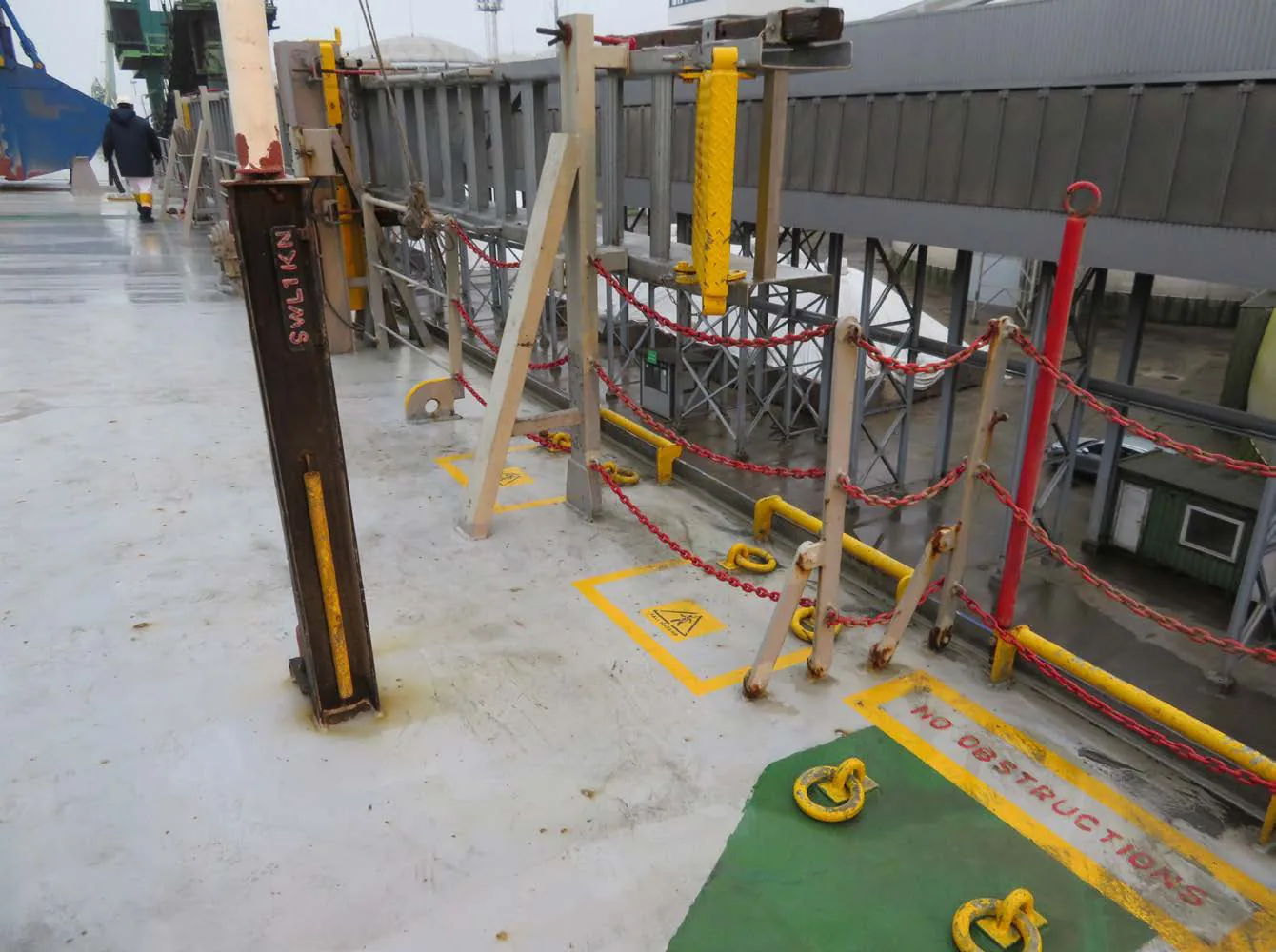
Rigging a pilot ladder is routine work on almost every voyage, and it puts crew right at an open deck edge. This summary of the MAIB’s investigation covers what happened, the risk, and where Dtyle.AI fits.
1. Incident
At 0840 on 14 October 2025, the bosun of the bulk carrier World Prize fell through an unguarded opening at the deck edge while the crew were rigging the pilot ladder, 3.5 nautical miles off Rönnskär, Sweden. He hit the accommodation ladder platform on the way down, entered 6°C water without a lifejacket, and drowned.
- Vessel: an Isle of Man-registered bulk carrier, built in 2021 and 200 metres long, leaving port in ballast with 19 crew and 2 pilots on board.
- Task: rigging a combination ladder (the accommodation ladder plus the pilot ladder) so the two pilots could leave by pilot boat.
- Outcome: one fatality. The pilot boat crew reached him within about two minutes but could not lift him aboard, and his body was recovered from the seabed the next day.
2. Timeline
World Prize left its berth at 0751 with two pilots on board, heading out to anchor.
- 0813: the tugs are released, and the master tells the second officer’s team to rig the starboard combination ladder.
- Shortly after: the chief officer joins, sends the second officer to rest and briefs the team; the safety chains at the pilot station are removed.
- 0824 and 0832: the master radios that the pilots will leave in 15 minutes, then asks for the ladder to be rigged early.
- About 0835: the pilot ladder snags on the accommodation ladder; the chief officer and bosun lean over the open edge, shouting to the able seamen 7 metres below.
- 0840: the bosun loses his balance and falls headfirst through the opening. The pilot boat reaches him at about 0842 but he slips under; the search is stood down at 1100.
3. Root Cause
The MAIB found that the bosun most likely overbalanced while leaning out to talk to the crew below or to check the ladder’s height, with nothing to stop his fall or keep him afloat.
- Nobody near the open deck edge wore the harness, fall arrest device or lifejacket the company’s procedures required.
- There weren’t enough handheld radios, so the only way to talk to the crew on the ladder platform was to lean over the side.
- The pilot ladder’s lifting davit was out of use, so the crew handled the ladder’s weight by hand, which pulled them towards the edge.
- There were no suitable anchor points near the pilot stations for fall arrest devices.
- Once in the water, his injuries and cold water shock meant he could not keep his airway clear.
4. Risk
Removing the safety chains to rig a pilot ladder leaves a 13-metre drop to the sea, and a fall into cold water can quickly become fatal, even with rescuers close by.
- Cold water shock causes an involuntary gasp on entry, whether or not the person is conscious.
- Someone injured in the fall may be unable to help themselves, so survival depends on a lifejacket and rapid recovery.
- Time pressure, such as a pilot boat waiting, pushes crew to work faster and take shortcuts.
- Similar falls have happened on other ships, including Navios Amitie and Nabucco.
5. Early Warning Signs
The unsafe way of rigging the ladder was visible well before the accident.
- Three days earlier, on arrival at Rönnskär, a crew member was photographed working on the accommodation ladder without a harness or fall arrest device.
- The shortage of handheld radios was raised at safety meetings in July and August 2025, but the order was never fulfilled.
- The permit to work ticked every safeguard, including harnesses, a safety net and lifejackets, none of which were in use.
- The deck markings around the pilot stations didn’t cover the full 2-metre hazard area.
- Several people were watching the work, but nobody stopped it.
6. How Dtyle.AI Helps
Where cameras cover the pilot embarkation stations and the water alongside, Dtyle.AI watches the open deck edge and the sea below it.
- Person Overboard Detection monitors waterside camera views and alerts the bridge when a person appears to fall or be in the water.
- Unsafe Act Detection highlights behaviours the operator defines as risky, such as leaning out over an unguarded opening, for review and coaching.
- Restricted Area Monitoring alerts when someone enters a configured zone, such as the 2-metre hazard area around an open pilot station.
- Gangway Monitoring keeps watch on the accommodation ladder and the conditions around it while it is rigged and used.
- Each alert reaches the bridge with a snapshot, the camera and the time, so the officer on watch can check it at once.
7. Prevention
Dtyle.AI can’t confirm that a harness is clipped to a proper anchor point or that a lifejacket is being worn, and it doesn’t replace guardrails, permits, radios or supervision. What it adds is a live, independent view of the work.
- An alert when crew enter the hazard zone at an open pilot station lets the officer on watch check the live view and stop the job if the safeguards aren’t in place.
- Flagging crew leaning over the edge gives supervisors something concrete to act on in the moment, not after an accident.
- Recorded clips of how ladders are actually rigged, compared with what the permit says, help managers spot unsafe habits before they become normal.
8. Response Support
Here, the pilot boat crew and the third officer saw the fall straight away. At night, or with no boat nearby, that might not happen.
- Person Overboard Detection alerts the bridge immediately, so a lifebuoy can be thrown and recovery started without waiting for someone to notice.
- The alert’s snapshot and location help the bridge direct rescuers to where the person entered the water.
- Where camera coverage allows, live views help the bridge keep track of the person in the water and guide the rescue boat.
- Recorded footage gives investigators and the company a clear record of what happened.
9. Lessons Learned
Because of the actions already taken, the MAIB made no recommendations. The changes include:
- The ship manager fitted tested anchor points for fall arrest devices at the combination ladders, put the pilot ladder davits back into service and re-marked the hazardous deck area.
- It supplied lifejackets compatible with the safety harnesses, and extra handheld radios.
- It reinforced crew members’ authority to stop unsafe work, and refocused training on behaviour, supervision and realistic scenarios.
- The Swedish Maritime Administration removed outdated recovery equipment and now includes all crew, including temporary staff, in man-overboard drills.
- The Isle of Man Ship Registry now requires ships to follow the latest UK Code of Safe Working Practices.
10. Key Benefit
An extra set of eyes on the deck edge during one of the riskiest routine jobs on board, and faster action if someone does go into the water.
- A better chance to stop unsafe work at an open pilot station before someone falls.
- Faster man-overboard alerts with the location, even when nobody sees the fall.
- Visual records that show whether procedures are followed in practice, not just on paper.
- Support for a safety culture built on managing risk rather than ticking forms.